

Robert Hein · May 22, 2026
Is McKinsey's orchestration layer missing the one step that makes it work?
McKinsey identified the orchestration layer enterprise AI needs. The diagnosis is right, but the layer belongs in the process, not in ERP.
McKinsey published its prescription for bridging the AI-ERP divide in January 2026. The orchestration layer they describe already exists. But it is not built on ERP.
In "Bridging the Great AI Agent and ERP Divide to Unlock Value at Scale" (Jensen, Deano, and Allison), the authors correctly identify why most enterprise AI programmes stall: only 40 percent of companies report any EBIT impact from AI, and the gap between investment and outcome traces back to a missing layer between AI ambition and operational reality. They call that layer an orchestration layer and describe precisely what it needs to do. The diagnosis is right. The prescription does not go far enough.
What McKinsey says needs to exist
From page 7 of the article:
It is important to wrap the end-to-end steps into a single workflow that links ERP events, AI logic, and business actions. An orchestration layer sequences the flow, pulling ERP data, sending it to the AI, receiving the recommendation, and writing the result back into ERP, and event triggers from the ERP ensure the AI runs only when something meaningful happens. Together, this creates a smooth, responsive workflow in which ERP and AI operate as one system, with intelligence applied exactly where work happens.
Precise. Correct. And incomplete in two important ways.
Where the prescription falls short
The first gap is architectural. McKinsey grounds the orchestration layer in ERP, which means it inherits ERP's boundaries. A layer anchored in ERP can see what ERP sees. It cannot natively span the supplier relationship managed outside the ERP, the outsourced service provider coordinating on the ground, the task management tool where field teams log progress, or the communication platform where escalations fire. The moment the process crosses a system boundary, the ERP-grounded orchestration layer loses the thread.
The second gap is more fundamental. McKinsey recommends embedding agentic capabilities "directly inside the steps where work gets done, approvals, planning, recommendations, forecasting, and exception handling" (p. 7) and building a "shared ontology grounded in ERP" to give AI "one consistent set of data definitions, process logic, and business rules" (p. 6). Both recommendations assume the workflow already exists as a digital artifact. For most organisations, it does not. It exists as institutional knowledge, email chains, status update meetings, and spreadsheets.
You cannot embed AI inside a workflow that has never been digitalized.
The premise McKinsey is missing
Every critical business function has dedicated infrastructure. Resources have ERP. Customers have CRM. Documents have CMS. Identity has IAM. Processes have nothing. They transcend all of these systems, span internal departments and external organisations, and are still run entirely by hand. Knowledge workers spend 60 percent of their time on coordination: tracking status, chasing updates, resolving issues, retracing steps when something fails.
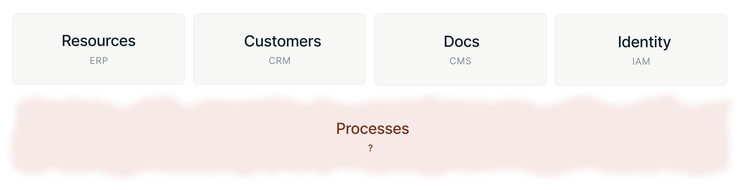
This is the foundational gap. Not an ERP gap. A process infrastructure gap.
Adding AI into a manually orchestrated environment does not solve this. It amplifies it. Without a process layer, AI agents operate with no control, no consistency, and no accountability. They make the existing fragmentation faster. The orchestration layer McKinsey describes cannot be built on top of ERP. It requires its own foundation: dedicated infrastructure where the process is the top layer and every system, including ERP, is a participant beneath it.
What that infrastructure looks like in practice
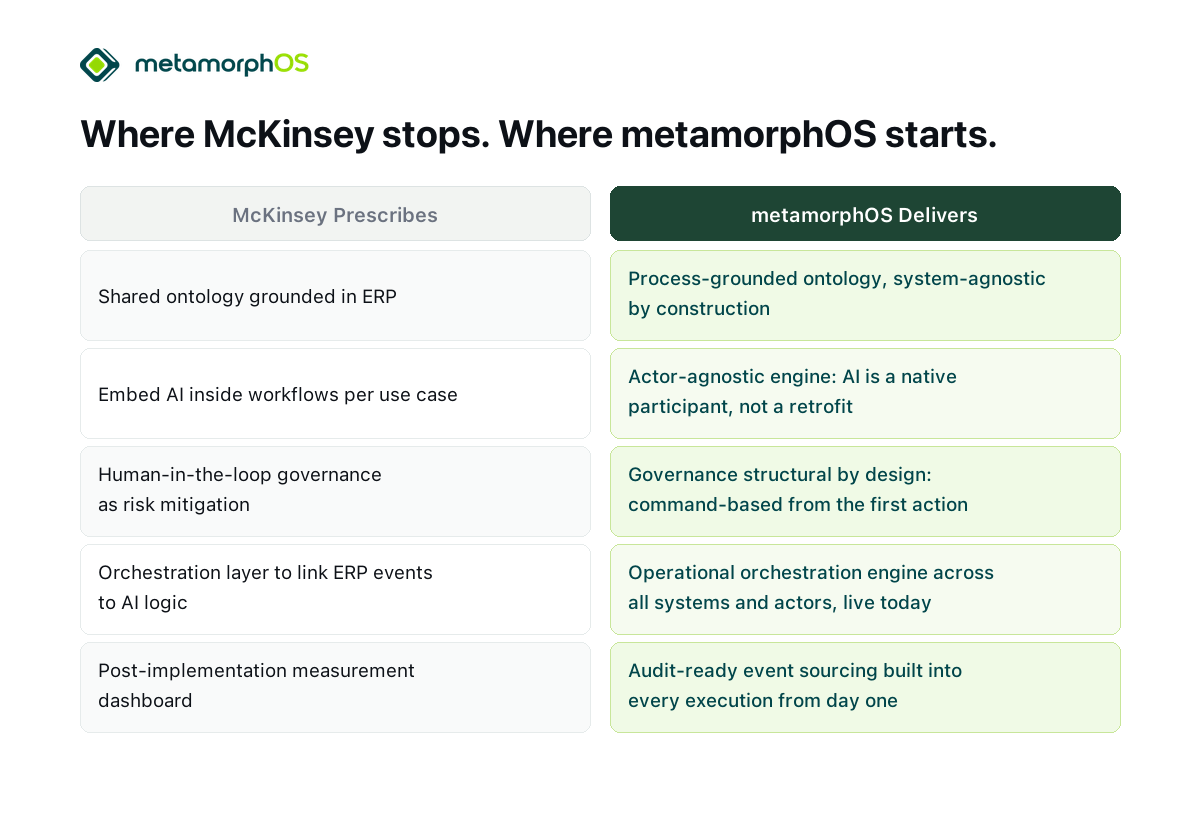
metamorphOS is built on exactly this premise. The platform's orchestration engine derives tasks from digitalized processes, contextualises them, and routes them to the right actor at the right time. The critical architectural decision is that the engine is actor agnostic. Tasks are assigned to humans, SaaS platforms, AI agents, or bots through a single authorisation system. AI is not a special case to be embedded into a workflow. It is a native participant type, receiving tasks the same way any other actor does. McKinsey's recommendation to place AI inside workflows is resolved here at the architectural level, not through integration work done case by case.
The foundation beneath the engine is command-based and event-sourced. Every action is triggered by a command, creating a clear chain of authorisation and accountability. Commands yield events that are immutably appended to a single source of truth, producing full traceability across every participant and every system. This is not a compliance dashboard added after implementation. It is audit-ready by design, from the first process execution. McKinsey recommends establishing "tight human-in-the-loop governance for high-impact decisions" (p. 8) as a risk mitigation measure. In metamorphOS that governance is structural, not configured after the fact.
Where McKinsey calls for a shared ontology grounded in ERP, metamorphOS grounds the ontology in the process. It is system-agnostic by construction. When a process spans a procurement platform, a task management tool, a real-time communication layer, an external supplier, and an outsourced service team coordinating across 140 locations, as in a live metamorphOS deployment, the process-grounded ontology holds the full picture. An ERP-grounded one cannot.
The sequence McKinsey skips
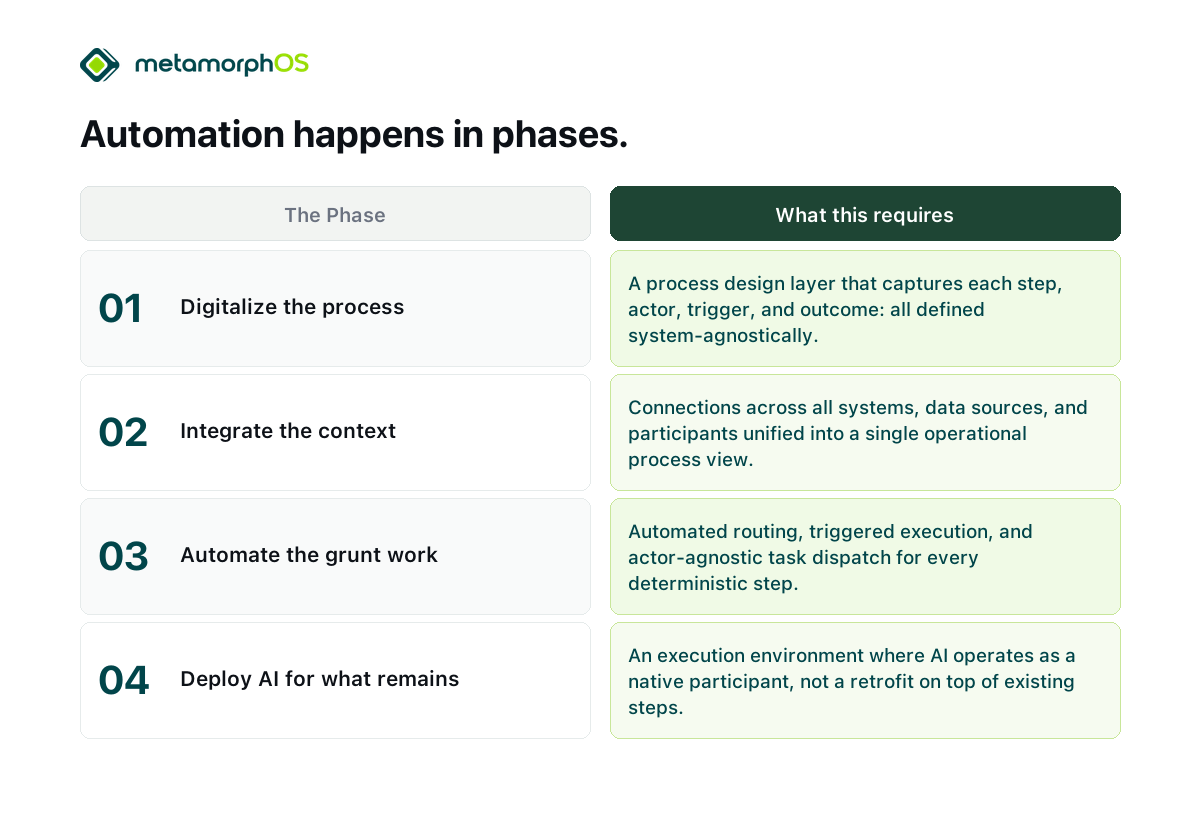
Automation happens in phases. Each depends on the previous. Skip one and the rest collapses.
- Digitalize the process.
- Integrate the context.
- Automate the routine work.
- Deploy AI for what remains.
McKinsey's article addresses phase four. The reason the majority of AI initiatives produce no measurable EBIT impact is not the wrong model choice or insufficient ERP investment. It is that phases one through three were never completed. The process was never digitalized. The context was never integrated. The routine was never separated from the judgment. AI lands in a manually orchestrated environment and the problems multiply.
The conclusion McKinsey points toward
McKinsey is right that an orchestration layer is the unlock. What the article does not resolve is where that layer is anchored. Anchoring it in ERP rebuilds the same system boundaries in a new form. The layer that works is anchored in the process itself, sitting above every system, treating humans and AI agents as equal participants in a digitalized workflow, and making every execution traceable from the first command to the final event.
That infrastructure exists. The question for most organisations is not whether to build it. It is whether they are willing to start at phase one.
Jensen, B., Deano, D., and Allison, M. (2026). "Bridging the Great AI Agent and ERP Divide to Unlock Value at Scale." McKinsey and Company, January 2026. Quotations from pp. 6, 7, and 8.
Robert Hein
Co-Founder & CEO, metamorphOS
Co-Founder and CEO of metamorphOS, and a serial entrepreneur and operator. He writes about giving operations a real operating system: orchestrating people, AI agents, and the systems teams already use, end to end.
Connect on LinkedIn