

Robert Hein · May 29, 2026
Why 72% of AI projects miss their ROI, and what Gartner's research doesn't explain
Gartner found only 28% of AI use cases meet ROI expectations. Melanie Freeze identified the right symptoms. The root cause goes one level deeper than IT.
Gartner's Melanie Freeze identified the right symptoms. The root cause goes one level deeper.
When AI projects fail, organizations look to their IT leaders for answers. That is the first mistake. Not because IT leaders aren't capable, but because the problem isn't where organizations think it is.
Gartner just published research that should be required reading for every executive with an AI initiative on their roadmap. In a survey of 782 infrastructure and operations leaders conducted in late 2025, only 28% of AI use cases fully succeeded and met ROI expectations. 20% failed outright. 57% of I&O leaders had experienced at least one failure.
These are not fringe findings from poorly resourced organizations. This is the current state of AI deployment across real businesses, real budgets, and real operational environments.
The question the data demands: if the technology is genuinely transformative, why is the failure rate this high? And why is it consistent?
What Gartner says is going wrong
Melanie Freeze, Director of Research at Gartner, offers a precise diagnosis in her interview accompanying the findings.
Failure is driven by unrealistic expectations. Teams assumed AI would immediately automate complex tasks, cut costs, and fix long-standing operational problems. When results didn't arrive quickly, confidence dropped and projects stalled.
Failure is compounded by poor scoping. AI initiatives that don't fit into the organization's operations simply cannot deliver ROI.
And failure is enabled by integration gaps. 48% of leaders cited integration difficulties as their top adoption challenge.
Freeze's prescription is equally clear. Embed AI into existing systems and processes. Manage AI use cases as products with clear ownership and measurable impact. Build shared evaluation criteria across IT, data, security, legal, and finance stakeholders.
The diagnosis is correct. The prescription is necessary. But it is not sufficient, because both share an assumption that the interview never examines.
The assumption nobody is questioning
When AI projects fail, organizations naturally turn to their I&O leaders. They do this because they have framed AI as a systems problem. Buy the right model. Configure the right infrastructure. Integrate the right tools. That sounds like IT's domain.
But the failure Gartner is documenting isn't happening in the infrastructure layer. It's happening at the point where AI meets operational reality. The handoffs that were never formally defined. The exceptions that live in someone's inbox. The approvals that require knowing exactly who to call. The cross-boundary processes that disappear the moment they leave your organization's systems.
That is not an IT problem. That is a business operations problem wearing an IT costume.
And so the failure loop runs like this: operations has a process that isn't working at scale. The business sees AI as the fix. The mandate goes to IT. IT deploys AI into an environment that was never structured to receive it. The project stalls. IT gets scrutinized for poor integration. The real cause, an undigitalized process, goes unexamined.
The cycle repeats. The budget grows. The ROI doesn't.
The premise Freeze's interview assumes but doesn't state
Back to Freeze's first success factor: "Embed AI into existing systems and processes." That recommendation assumes the process exists as a structured, executable artifact. For most scaling organizations, it does not.
The process exists as institutional knowledge held by specific people. Email threads that double as approval trails. Manual entries in a partner's system. Spreadsheets that became the system of record. Meetings that exist to compensate for missing structure.
You cannot embed AI into any of those. Not reliably. Not at scale. Not in a way that produces consistent, governed, measurable outcomes.
The integration challenge Freeze identifies, cited by 48% of leaders as their top barrier, is not primarily a technical problem. It is a process infrastructure problem. The AI has nowhere structured to land.
The missing step in every AI roadmap
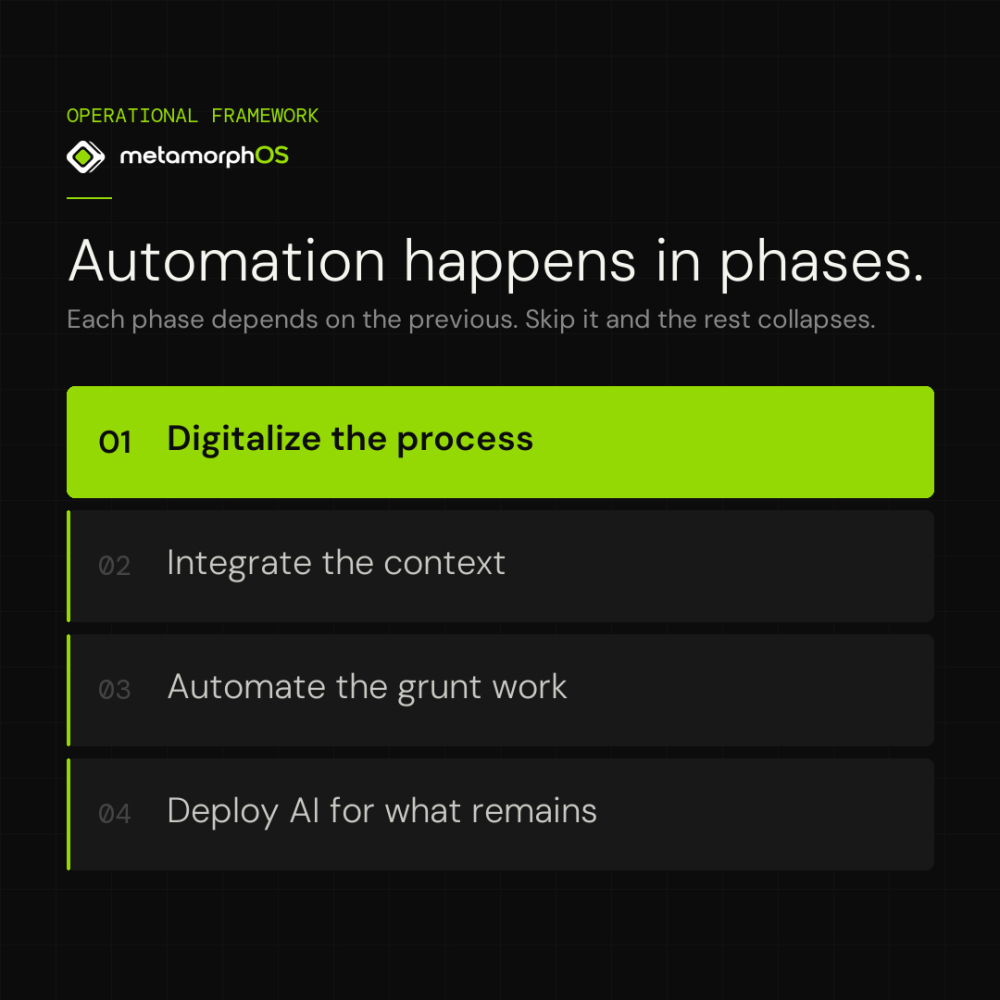
Automation happens in phases. Each one depends on the previous. Skip one and the rest collapses.
- Digitalize the process.
- Integrate the context.
- Automate the routine work.
- Deploy AI for what remains.
Gartner's research, and most AI deployment thinking, addresses phases three and four. The reason 72% of projects stall is not wrong model selection, insufficient budget, or unclear ownership. It is that phases one and two were never completed.
The process was never digitalized. The context was never integrated. AI arrived in a manually orchestrated environment and the problems multiplied. Freeze's "integration difficulties" are phase one and two problems wearing a phase four label.
The infrastructure gap nobody talks about
Every critical business function has dedicated infrastructure. Resources have ERP. Customers have CRM. Documents have CMS. Identity has IAM.
Processes have nothing.
Processes transcend every system. They span internal teams and external organizations. They involve humans, AI agents, partner systems, and legacy tools simultaneously. And in most organizations, they are still run entirely by hand.
Gartner is speaking specifically about IT infrastructure and operations. But the same finding applies to every operational function in a scaling business. Procurement. Fulfilment. Finance. Compliance. Supply chain. The infrastructure gap isn't a technology problem. It's an operations problem that predates AI entirely. AI is not creating this gap. It is making it more expensive and more visible.
This is not an IT problem. Ask your COO.
Let's leave the IT department for a moment, because this problem isn't unique to technology infrastructure. It's the daily reality of every operations leader running a scaling business.
You tripled revenue in eighteen months. The processes that worked at one third of the volume are visibly straining. Your best operators are single points of failure. Status updates require chasing, not checking. Compliance documentation is assembled retroactively. You find out something went wrong from a customer, not from your team.
Your CEO is asking about AI. Your board wants to see a roadmap. And somewhere in the organization, an AI initiative has been scoped, budgeted, and handed to IT.
Here is what will happen next, if the pattern holds: IT will attempt to integrate AI into the operational environment they find. That environment will be a patchwork of email conventions, spreadsheet workarounds, partner system logins, and tribal knowledge. The AI will have nothing structured to run inside. The project will stall. And the operation will keep breaking in exactly the ways it was breaking before.
The COO's response to an AI initiative should not be "great, keep me posted." It should be "before we deploy anything, are our processes digitalized enough to receive it?" That question is not an IT question. It is an operations leadership question. And it is the one almost nobody is asking.
What AI-ready operations actually look like
An AI-ready operation has digitalized its processes before deploying AI. Every step has an owner. Every handoff is defined. Every decision has a rule. Every exception has a path.
In that environment, AI is not being asked to fix the process. It is being asked to execute a specific, well-defined step inside a process that already works without it. That is a completely different ask, and it is one AI can consistently deliver on.
This is why organizations that start with process digitalization reach 90%+ automation rates within three months. Not because the AI improves, but because the process becomes progressively more explicit. And explicit processes are precisely what AI needs to deliver ROI.
Freeze's success factor, embed AI into existing systems and processes, is exactly right. The prerequisite is that those processes have to exist as something embeddable. That is the step her interview doesn't cover. It is also the step that determines whether you are in the 28% that succeed or the 72% that don't.
The question every leader should ask before the next AI deployment
Before the next AI use case is scoped, funded, or handed to IT, ask one question:
If I needed to hand this process to an AI agent tomorrow, could I describe it precisely enough for it to execute without asking a single question?
If the answer is no, the AI project is not ready. The process is not ready.
This is not a reason to delay. It is a reason to start differently. Making a process AI-ready does not require a multi-year transformation program. It requires starting with version one, getting it running, and letting it evolve. The organizations in the 28% didn't get there because they had better AI. They got there because they built better foundations.
The infrastructure for AI already exists. It is called a digitalized process. Build that first. Then hand it to IT.
Robert Hein
Co-Founder & CEO, metamorphOS
Co-Founder and CEO of metamorphOS, and a serial entrepreneur and operator. He writes about giving operations a real operating system: orchestrating people, AI agents, and the systems teams already use, end to end.
Connect on LinkedIn